
A beautiful build in New York’s Hudson Valley preserves the natural public ridgeline and maintains regional wildlife corridors.
When the family acquired a forested cliff overlooking the Hudson River Valley, they planned to build a contemporary home, garage, and pool. They also wanted a home that felt at home in the forest, as if it had existed there for generations. So we challenged them and their contractors to clear as little forest as possible, protect the native topsoil, and draw plants from the surrounding woodland understory. Our intention was to prove that ecological stewardship and high-end residential design can coexist without the destructive clearing typical of new builds. The result is a magical mix of modern and old: a state-of-the-art home and outdoor living spaces, including a pool, bluestone patios, a hot tub deck, and a fescue play lawn, nestled comfortably among mature trees.
Keeping ecosystem integrity intact
For this project, the goals were to site a new house and home landscape to seamlessly integrate into the surrounding forest; optimize connections between the home and landscape; and preserve and enhance the meadow, forest, and viewsheds. The site had high ecosystem integrity, with very few invasive species, connectivity to larger woodland corridors, and valuable wildlife habitat.
The 10,000-square-foot house was sited in a previously disturbed area of the dense oak-, pine-, and hemlock-dominant forest, with access along an abandoned logging road. That allowed the team to reach the cliff top without cutting new routes through the canopy, eliminating extensive grading and preserving mature forest for a seamless visual and ecological transition into the woodland edge.
Committing to limited disturbance
Building sustainable landscapes that are resilient to climate change starts with minimizing disturbance to functioning ecosystems. With a new build, that means questioning what disturbance is truly necessary, then writing clear guidance: where machinery can go, which trees stay, and where soil is stockpiled.
We worked with the clients, architect, engineers, and site contractors to establish a strict “limited disturbance” perimeter averaging 25 feet from the structure, with the closest point just 13 feet from the foundation to a mature oak. We cleared only 0.5 acres for the house, garage, and pool.
The team identified trees within the disturbance zone for protection, carefully stockpiled and redistributed soil horizons, and improved areas previously disturbed by logging. We sited the driveway and septic infiltration field in already disturbed and cleared areas and utilized smaller machinery around the back of the house to minimize root disruption.
These limitations were more restrictive than on typical projects. They slowed down the site work somewhat and made sequencing very important, but the whole team kept the ecological goals in view throughout the long build and addressed complications collaboratively and creatively. As a result, we preserved significantly more of the existing forest and meadow than is typically possible.
Taking care of the soil
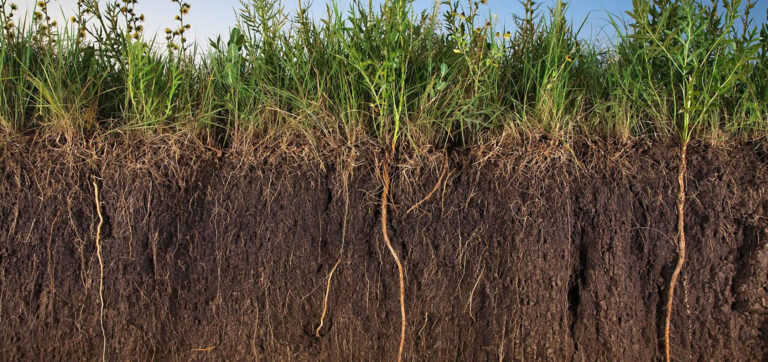
Most conversations about green building focus on energy use and materials. However, as our Healthy Soils guide for site design and construction explains, soil is one of Earth’s largest carbon reservoirs. Because disturbing soil releases carbon, site work can affect a development’s net emissions more than energy use, materials, or long-term use.
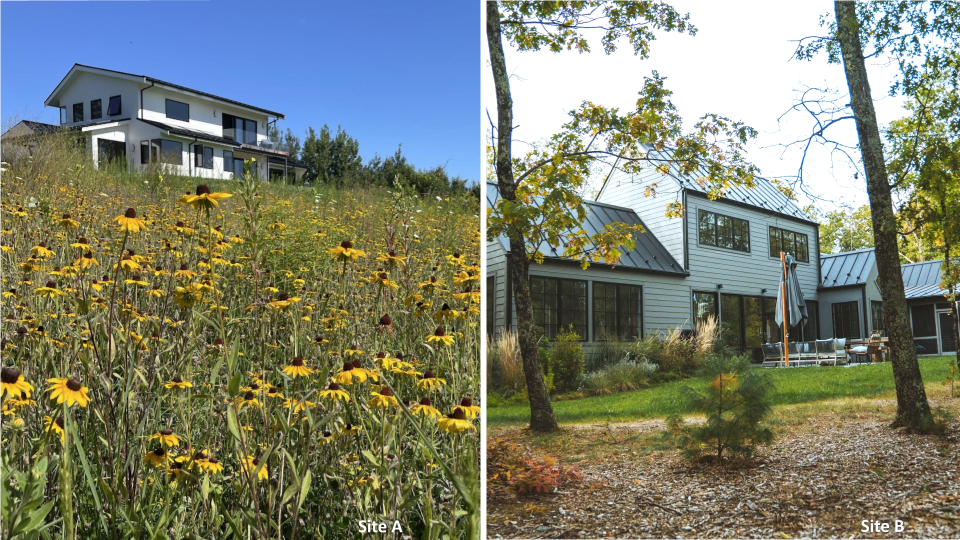
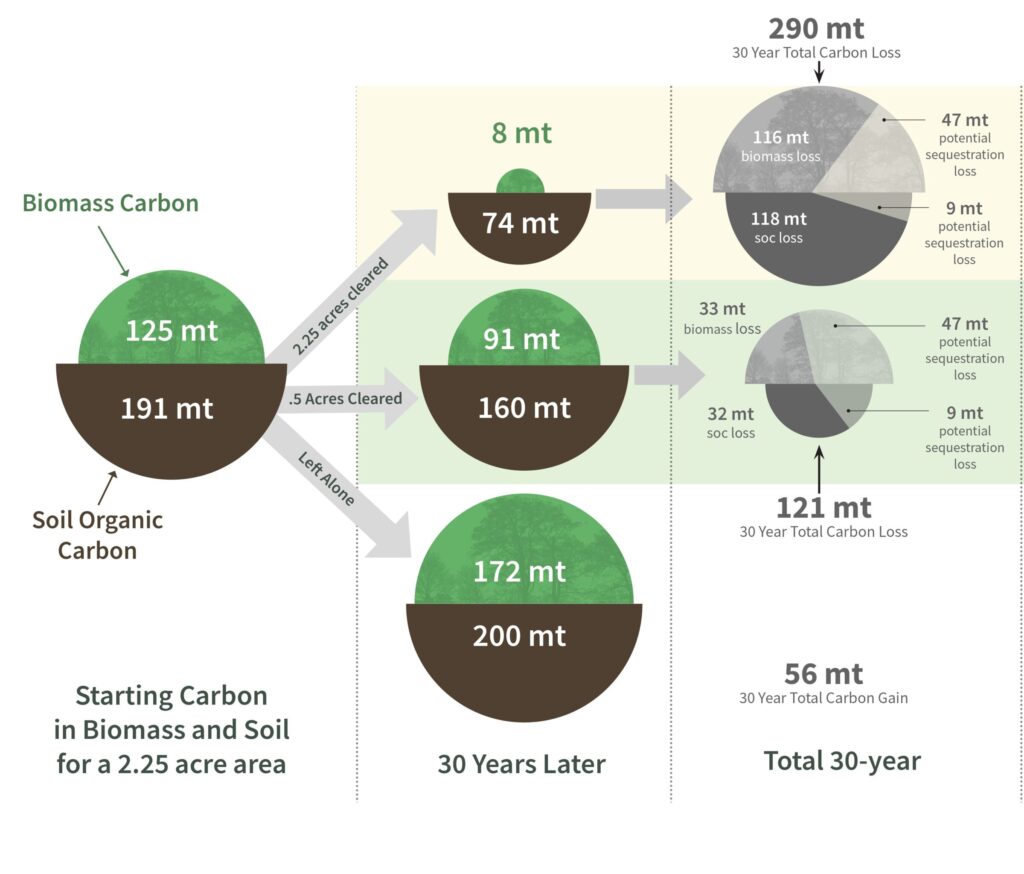
Let’s compare this “limited disturbance” project (Site B) to a more typical build (Site A). Both clients said they wanted an “ecological + sustainable outcome.” Site A was led by the site developer and contractor, while Site B was strongly influenced by our team at RDG. The site prep and restoration were radically different as a result.
Site A began with the standard practice of clearing all vegetation, stripping and stockpiling (and selling) the topsoil, followed by radical grading. More than two acres were fully cleared. Inroads were made to re-establish a diverse, healthy plant community, but the water infiltration capacity, nutrient profile, and soil carbon levels were profoundly, and semi-permanently, impacted by the heavy disturbance approach typical of most projects. The degree of compaction was high across the site, and the thin ‘frosting’ layer of topsoil is insufficient to address this. More significant de-compaction and additions of organic matter would be necessary to restore the soil functions, including ability to support healthy plant communities.
Both sites look good a year later, but their soils are on very different paths. Over 30 years, the typical build loses 290 metric tons of carbon, while the “limited disturbance” site will lose about 121. The standard practices reduce the soil’s ability to support plants and hold water.
At home in the forest
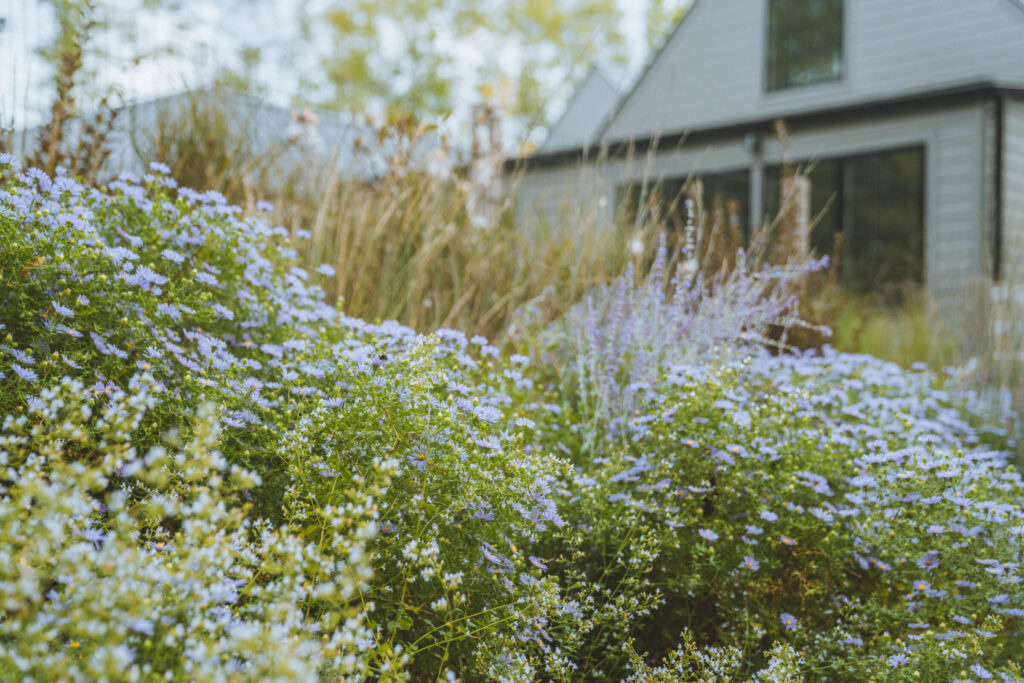
The resulting home feels integrated with the forest, with native perennial shrubs and groundcovers to soften the edges of the disturbance. Foundation plantings drawn from the surrounding woods and meadows, seed mixes including one grown from seed collected on the property, and a small fine-fescue lawn filled in within one season. Bluestone, Kebony, and a cedar fence that disappears under vines tie the house to its setting.
“The landscape melds into the forest…and it feels like it is all interconnected. As you drive up the gravel driveway you see a graceful transition between forest, meadows, landscaping, and entryway. The house sits very naturally in the setting. The pool and landscaping feel as if they belong in the forest.”
— Client
This project provides an adaptable model for contractors building in sensitive woodland areas. The most significant step designers, site workers, and reviewing bodies like planning boards and conservation commissions can take to protect the health of soils and watersheds in rural or undeveloped areas is to replace standard practices of clearance and grading with a more constrained and responsive approach.
By questioning every foot of disturbance and respecting natural site systems, this project proves that modern residential living can actively protect vulnerable forested landscapes.
Learn more on the project page and the Massachusetts Healthy Soils Guide for Site Design + Construction.