The Massachusetts Woodlands Connect initiative is a state-wide collaborative effort to improve forest stewardship services for underserved forest landowners. It is bringing together key partners and community leaders to develop programming and implement projects that align with existing state goals to increase forest conservation and resilience, while creating new pathways of engagement for historically underserved land stewards.
Partners on the project include Service Forestry, a division of MA DCR’s Bureau of Forest Fire Control and Forestry, Pocasset Pokanoket Land Trust, a tribally-led nonprofit dedicated to reconnecting communities of American Indian tribes, clans, Urban Indians, and indigenous people across the Northeast, and Regenerative Design Group. The public-private partnership is grounded in traditional ecological knowledge, sustainable forestry and agriculture, multi-stakeholder facilitation, and community outreach.
Funding for the project was secured through a five-year, non-competitive grant under the 2023 Inflation Reduction Act to State Forestry Agencies.


Building Bridges between Forestry and Agriculture
Traditionally, forestry is the practice of managing wooded land for timber. State forestry services were developed in the early 1900’s to help private landowners decide which timber to harvest when in order to maximize economic gains and minimize ecological harm. However, over the past decade, the number of private forest owners harvesting timber has declined. Landowners are increasingly interested in managing their forestland for other amenities such as recreation, wildlife habitat, hunting, or privacy.1 At the same time, forestland has become increasingly fragmented due to development, severe weather events, and declining forest health. With an intractable legacy of settler colonial ownership structures and a history of near-total deforestation in the 18th and 19th centuries, the way we interact with and manage forests in Massachusetts has undergone immeasurable changes over the potential lifespan of one single tree.
Today, trees are viewed as vital ecological resources for offsetting global carbon emissions and maintaining clean air and water for Massachusetts residents. Forestry services for landowners are changing too, with new programs, such as the Climate Stewardship Incentive Program (C-SIP), providing cost-share payments to landowners with active Forest Stewardship Plans for practices that enhance soil protection, carbon retention, and forest adaptive capacity.
While effective, these stewardship programs often struggle to reach underserved landowners who face additional social, economic, and technical barriers to participation. Woodlands Connect is working to build new bridges between landowners and service providers and create responsive, innovative pathways to increase engagement in healthy forest stewardship activities. The program hopes to bolster strategic local economic opportunities through emerging markets in agroforestry, carbon credits, and ecotourism. Increasing awareness of land care and management strategies that challenge the long-standing Eurocentric silos between forestry and agriculture is of particular interest to underserved and indigenous communities, many of whom have traditional ways of relating to the land that include forest gardening and foraging for wild edibles, medicine, and traditional craft materials.


Centering Equity and Community Relationships
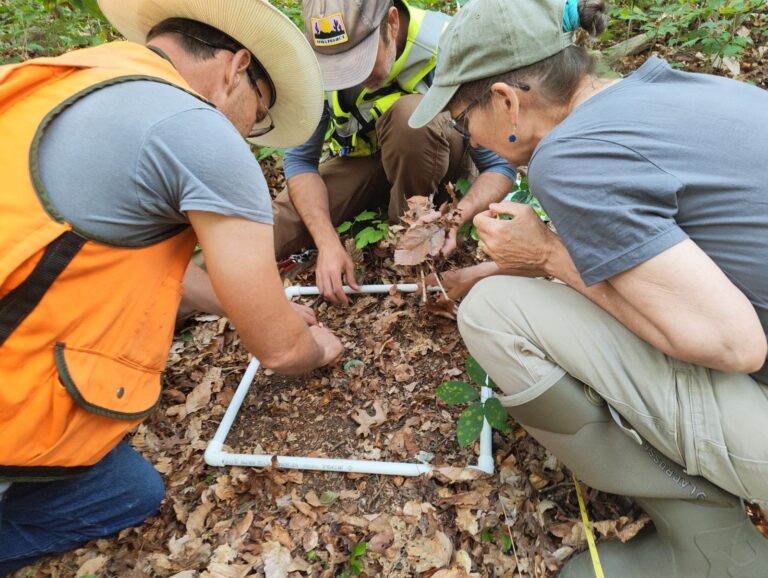
In July 2025, the Woodlands Connect initiative kicked off with a gathering of land stewards and stakeholders at Global Village Farm in Grafton, MA, with a conversation around key barriers to accessing state-funded forestry programs and cost-share incentives. Participants shared the hurdles they have experienced in working with the state to manage forestland and engage in other forest-based economic opportunities, such as agroforestry. Forest walks, shared food, and a hands-on workshop building air-prune nursery beds offered engaging opportunities to learn from and connect with each other. The event welcomed 76 diverse attendees and sparked new enthusiasm for the potential to craft an equity-centered agroforestry program across the state.
Last fall, stakeholders began convening monthly to form a steering committee that would guide the development and implementation of programs that would move beyond traditional models of landowner assistance and support more innovative, community-led practices and peer-to-peer knowledge sharing. The committee strongly values transparency, reciprocity, and building authentic trust with veteran and BIPOC communities who have suffered state-sponsored discrimination and neglect in the past. Agroforestry has emerged as a top priority area because of its deep roots in agroecological land care and indigenous cultivation techniques, and because it challenges many of the systems and structures of commercial forestry and Big Ag. It represents an opportunity to rethink our extractive relationships to land and commodification of natural resources, and begin thinking more in terms of kinship networks and cooperation among people, land, and nature.

Seeing the Forest and the Trees
The Woodlands Connect Steering Committee is now devising an agroforestry pilot program that would offer the technical and social infrastructure needed for more widespread adoption. The program will weave together both forward-thinking forest stewardship practices and community relationship-building initiatives currently lacking in DCR programs, incorporating hands-on, peer-to-peer learning opportunities coupled with ongoing mentorship and financial support for participants. Most importantly, the program will be flexible and responsive to the needs of the communities served, with a measurable impact on land stewardship across the state and meaningful resourcing of community partners and practitioners.
Woodlands Connect is a cross-cutting, multi-stakeholder initiative operating at the intersection of state governance and community organizing. It is tasked with elevating the underrepresented voices of landowners and community leaders to help shape new policies and programs that address real individual needs, while working within the existing apparatus and current capacity of state agencies. It is both an opportunity and a challenge to make incremental changes while keeping the larger context of unequal land access, economic growth mandates, and political strata in mind. RDG is grateful for the partnerships forming through this initiative and eager to help steward the creation of new opportunities for all forest stewards in Massachusetts through reciprocity, transparency, and the slow, essential work of building authentic trust.
1 USDA Forest Service. 2025. USDA Forest Service National Woodland Owner Survey dashboard (NWOS-DASH) [online]. Madison, WI: U.S. Department of Agriculture, Forest Service, Northern Research Station. Go back ↑